Marriage
The Girl he Never NoticedMarriage is the state that transforms Cameron Hillier and Liz Montrose’s uncertain attachment into a publicly recognized family. At first, it is offered as a practical arrangement: Cam needs a mother for Archie, Liz needs a father and settled background for Scout, and his name may protect her from the custody fears surrounding Scout’s unknown father. The story therefore treats marriage both as an emotional commitment and as a social and economic instrument, before resolving the tension by showing Cam and Liz marry for love and remain together as a family.
Marriage as Protection and Stability
Marriage enters the story through Liz’s anxiety about Scout’s father. Liz is a single mother who has kept Scout’s birth from the man who once did not want the child to be born. Although she insists that she wants to keep the truth from him forever, she recognizes that Scout may eventually want to know her father. Her deeper fear is that Scout’s father and his wife, who have been married for four years and have no children, might somehow draw Scout away by offering a settled home and greater prestige. Liz compares their apparent security with her own precarious position, saying that she is merely getting by and worrying that her financial circumstances could be used against her if her suitability as a mother were challenged.
Cam answers this fear in legal and practical terms. He tells Liz that she is Scout’s mother and that Scout cannot simply be taken from her unless Liz cannot provide for the child. His reassurance does not remove her anxiety, because she distinguishes between formal legal protection and the other pressures that might influence a child. When she accepts the position at Yewarra, she explains that the improved finances, the possibility of working from home, and the additional time with Scout would make her appear more suitable if Scout’s father ever contested her suitability. Marriage consequently becomes linked to the story’s recurring concern with the vulnerability of single motherhood: it promises not only affection but a stable household, material resources, and the visible authority of Cam’s family name.
The Proposed Practical Union
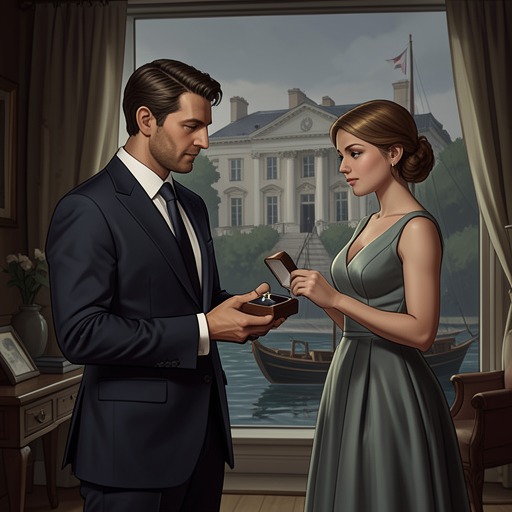
Cam first proposes marriage when Liz says that she cannot move in with him. He presents it as another option rather than as a romantic declaration. His reasoning is deliberately concrete: he needs a mother for Archie, Liz needs a father for Scout and a settled background, and she could hardly find a more solid background than his home. He also argues that Liz has already settled into Yewarra and its life so completely that, whether or not she loves it, she has given an excellent imitation of belonging there.
The proposal is complicated by the fact that the relationship is not merely an arrangement between two adults. Cam openly includes Archie and Scout in his calculation, imagining marriage as a structure that would connect two children who already stand at the center of their parents’ decisions. Liz loves Archie, and Cam knows that she has become part of Yewarra’s domestic life, but the practical language of the proposal makes her fear that her emotional value has been reduced to her usefulness as a mother. His suggestion therefore brings the marriage plot into direct contact with the employer-and-employee basis of their relationship. Cam is her employer, while Liz began as his diary secretary, and the proposed union risks making affection indistinguishable from provision, protection, and domestic service.
Yet Cam also insists that their connection cannot be dismissed as a temporary encounter. He tells Liz that they are not going to be a one-night wonder and that they could not have felt so intensely for two “crazy months” if the relationship were insignificant. He describes those months as a form of torture, capturing the contradiction at the center of the proposal: marriage is spoken of as a sane solution to practical problems, but it is being considered because their attraction has become too powerful to contain within professional boundaries. The apparent convenience of the arrangement thus conceals a relationship already charged with mutual desire and emotional dependence.
Crisis, Misunderstanding, and Renegotiation
When Cam announces to Mary Montrose that he and Liz have agreed to marry, the declaration intensifies rather than settles the conflict. Liz is unable to accept the announcement as proof of love, particularly because she remains guarded about her past and cannot easily expose her feelings. She tells Cam that the proposed marriage is not what she wants and decides that she and Scout should leave the next morning. In the painful conversation that follows, she concludes that the relationship could never work because it contains too many unresolved issues, and she asks Cam to let her go.
Cam then clarifies the basis on which he thinks he can offer marriage. He admits that he is prepared to give Liz the protection of his name if she believes it will safeguard Scout from her father, but he calls it a marriage of convenience. That qualification is devastating because it confirms Liz’s fear that marriage might be an arrangement made for Scout rather than a choice made for her. The value of marriage shifts sharply from promised security to emotional rejection: the same name that could protect Liz legally and socially now seems to deny the love she wants from Cam.
The crisis is resolved when Cam changes the terms of the proposal. After their separation has brought the relationship to the point of collapse, he asks Liz to marry him instead. Liz says that she cannot think of anything she would rather do, although she warns him that she can be difficult, outspoken, and fighting mad. Cam answers by acknowledging those qualities rather than demanding that she become easier to live with. Their exchange reframes marriage as a partnership between two imperfect adults whose differences may complement one another. The practical foundation remains present, but it is no longer allowed to stand in for emotional commitment.
The Wedding and Shared Family
Cam and Liz marry several weeks later on Whitehaven Beach. The ceremony joins romance, spectacle, and family integration. They arrive by helicopter with Archie, Scout, and the marriage celebrant, while the guests travel from Hamilton Island on Leilani and another boat before being ferried to the beach by tender. Liz wears an ivory lace-and-tulle dress made by her mother, with flowers woven into her hair; Cam wears a cream suit, and both children wear sailor suits. Everyone is shoeless, giving the wedding an unconventional informality despite the elaborate arrangements surrounding it.
The setting completes the movement from private fear to public recognition. As the sun sinks, Cam and Liz are pronounced husband and wife, and the guests fall quiet while the couple look only at each other. The sky and water turn liquid gold, making the scene a visual expression of the emotional transformation that the marriage has accomplished: a relationship once disguised as employment, argued over as protection, and threatened by departure is now openly affirmed. Afterward, the guests return to Leilani for a feast, while Archie and Scout remain with Cam and Liz as they cruise the Whitsundays for the next couple of weeks. The children are not peripheral witnesses to the marriage; they are part of the household the marriage creates.
Meaning and Continuing Life
The marriage resolves several forms of insecurity at once. It gives Liz a more secure domestic and financial position, offers Scout a recognized father figure, and gives Archie the mother Cam said he needed. It also absorbs Liz into the life of Yewarra, a place she had already learned to inhabit despite her fear that she did not truly belong there. Marriage changes that belonging from an imitation into a chosen family structure shared by Cam, Liz, Archie, and Scout.
The ending confirms that the union is not merely a protective legal fiction. Twelve months later, Yewarra is flourishing after good rain, and Liz is walking among its massed roses when Cam returns from several days away. Even after a year, his appearance still makes her pulse race. This detail gives the marriage an ongoing erotic and emotional vitality rather than presenting the wedding as the endpoint of desire. The state of marriage therefore carries the story beyond the convenient solution Cam first proposed: it becomes the durable form of a love that has survived fear, misunderstanding, separation, and the pressure of family responsibility.